
US China technology competition Dimon has brought to the forefront the critical vulnerabilities facing the United States in the escalating global technology arms race. JPMorgan Chase CEO Jamie Dimon’s unvarnished comments have served as a wake-up call, emphasizing that the US cannot afford complacency when dealing with a determined and well-resourced strategic competitor like China. Dimon’s core warning highlights dangerous dependencies, particularly in areas of critical manufacturing and essential technology components.
It is, as he bluntly put it, “a little embarrassing” that the US has allowed itself to become 100% dependent on China for vital supplies like penicillin, rare earth metals, and advanced chipmaking tools. This situation not only presents an economic risk but, more critically, a profound national security risk in an era where technological supremacy directly translates to geopolitical power. The ongoing rivalry is not just about market share; it’s a battle to define the rules and standards of the 21st-century technological landscape.
The Core of Dimon’s Warning: Dangerous Dependencies

The root of Dimon’s warning is the strategic hazard of a fragile supply chain and a business dependent on a single source. Specifically, Dimon has noted that the United States relies on China for rare earth metals and key pharmaceuticals like penicillin. This dependence creates a point of leverage for Beijing, one that may be used during any geopolitical crisis. And the perception that America is lagging behind in developing its own sources of such foundational materials, including critical defense capabilities like ursa major stratolaunch hypersonic technology, only deepens both an economic vulnerability and a military weakness. This reliance itself breeds the kind of US-China tech competition infrastructure failure he often speaks out against–and therefore warrants strong, immediate domestic investment now.
The Great Decoupling: Fragmentation in Global Tech
As the technological competition between China and America escalates, the worldwide technology ecosystem is becoming increasingly split and “decoupled.” The U.S. controls the process by holding up exports of advanced semiconductors. At the same time, China speeds up its quest for technological self-sufficiency.
Brazil. The split now compels still other nations and multinational corporations to choose their sides, disrupting established global supply chains and hiking costs. The danger down the line is that there could emerge two separate technology blocs, which are non-interoperable with each other. This will slow global innovation and make the geopolitical gap even wider.
The Central Battlefield: Artificial Intelligence (AI) and Semiconductors
Semiconductors and Artificial Intelligence (AI) are the two most fiercely disputed territories in Sino-U.S. high technology competition. AI, as viewed by both countries, is the key technology for future economic growth and military superiority. This involves not only autonomous systems but also cognitive warfare. Semiconductors, or microchips, are the indispensable hardware for AI and almost all modern technology. With his support of such a cause, US strictures like the Administration imposed on advanced Nvidia chips going to China aim to box China in developing powerful AI systems, for which Dimon said last week, “You don’t want to give them chips that will make their supersonic missiles better.”
China’s “Whole-of-Society” Approach vs. US Market-Led Innovation
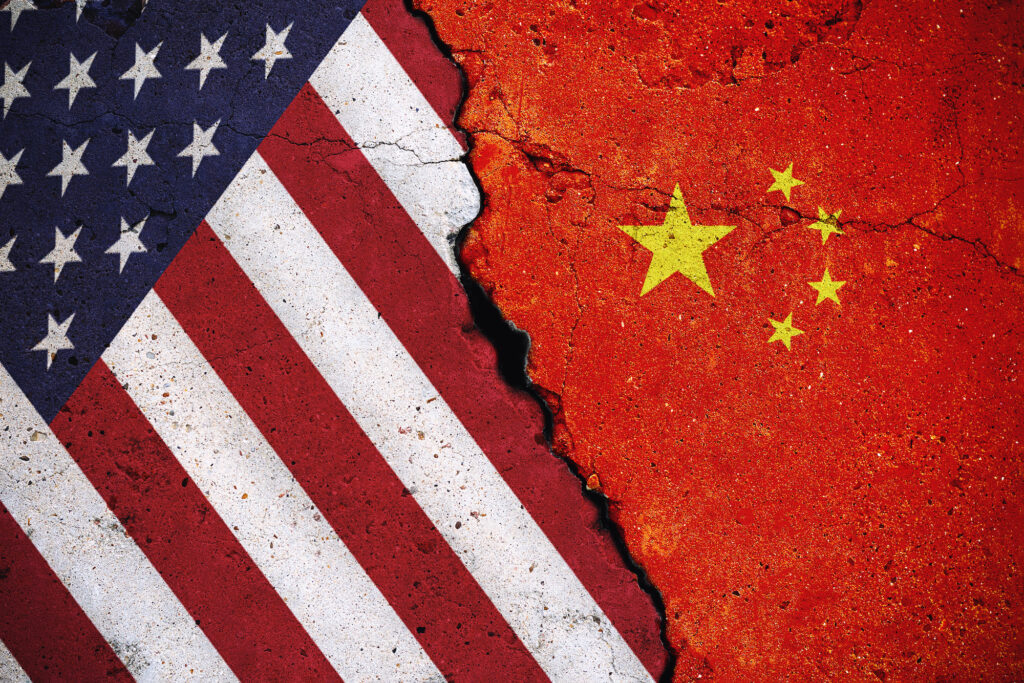
A key point of difference between the camps is in technological development philosophy. Operating with a “whole society” approach, China funds and directs all of its technology development so that technology has a strong military bias in efforts termed “military-civil fusion.” Commercial and military R&D are completely blended.
By contrast, America’s method is overwhelmingly market-oriented and driven largely by private enterprise. Dimon is warning that the United States needs not just to rely on private initiative but to re-examine and perhaps substantially increase federal research support. It is only at that state-oriented scale of effort that has been put into China. China’s methods of handling problems come from Marshall-style efficiency. As one American executive remarks, one product in a factory takes “100,000 engineers.”
Protecting the Edge: Intellectual Property and Cyber Espionage
For the United States, intellectual property (IP), trade secrets and state-of-the-art scientific experiments are among the things that keep it in the top position of global leadership. But this superiority is constantly threatened by China’s aggressive cyber-espionage, intergovernmental technology transfer and the like.
Dimon’s deeper worry is the continuing theft of technological knowledge from the United States. In future fields such as quantum computing and the sophistication of advanced biotechnology, protecting these will take more than merely having laws in place; it also means building up critical infrastructure so as to keep up one step ahead when government-sponsored bandits come calling.
The Urgency of Domestic Reform and Investment
According to Dimon, although China is a competitor, it is an external one; the United States must address its own internal weaknesses as well to win over competition in the long term. He is calling for an increase in domestic reforms in many areas, such as infrastructure permits, regulation, immigration, and education.
He hopes that by getting these things right domestically, this would give us greater economic growth and resilience, the only proper basis from which we can hope someone else achieves technological leadership. This cry for self-improvement is an integral part of his admonition: often the biggest threat to America comes from within rather than without, due in no small part to our own fault-ridden management and innumerable splits.
Geopolitical Implications: The Role of US Allies
The technological competition between the United States and China is meaningless to Dimon without taking on the challenge of building alliances. Developing and retaining partnerships is a critical part of any successful strategy.
It is essential to work with key partners like Europe, Japan, South Korea and Australia in order to gain more favorable trade terms, carry out effective export controls and establish unified technological standards. Collective action is not only necessary for economic leverage; it is also key in shaping the path towards creating trusted supply chains worldwide outside China’s direct influence, and forming a unified front under after rules-based global technology order.
Financial Sector and Capital Flows: Wall Street’s Role
The finance sector, including JPMorgan Chase, is being drawn into the trade war machine directly. Even US lawmakers are beginning to scrutinize Wall Street’s continued investment or underwriting of Chinese companies, especially if they have some relationship with China’s military-civil fusion strategy (like battery giant CATL). Dimon’s warning thus indirectly raises the tricky issue of how American financial institutions can divorce their operations and investments from China, with America’s national security interests at stake. There’s a huge dilemma in striking this balance between shareholder value and national strategic goals.
The Broader Context of Technological Supremacy
Another tech-rivalry advantage points to lots other than chips or AI. Power in these crucial future areas will determine who has global influence:
- Quantum Technologies: Both countries are investing heavily in quantum research, from computing to sensing and communications. Its dominance could bring advances in encryption, drug discovery and military force.
- Biotechnology: In gene editing (CRISPR), pharmaceuticals, genomic data and beyond, competition is fierce. Ethical questions have been raised by China’s attempts to infiltrate global supply chains with its biotech firms.
- 5G and Next-Gen Connectivity: An international race for standards and infrastructure for 5G networks and future 6G ones that has economically broad implications. A strategic challenge to China’s initial leap ahead is just getting underway.
- Green Energy Supply Chains: China dominates the manufacture of advanced batteries and recovery of many basic materials used for renewable energy and electric cars (EVs), putting the focal point of U.S. dependence in another place. In turn, the US dominates China when it comes to finished high-tech products.
- Cyber Warfare Capabilities: This is a continuous, escalating battlefield, like the Cold War’s nuclear SALT negotiations or Vietnam. The capacity to hit and protect critical national infrastructure via computer-based means has become an integral part of any disagreement between two great powers.
Frequently Asked Questions
What does Jamie Dimon mean by US vulnerability?
In Dimon’s thinking, there is risk in relying overly on China for critical goods when delivery times can take longer than expected.
Why are semiconductors so central to this competition?
Semiconductors (chips) are the core hardware for all advanced technologies, including Artificial Intelligence (AI) and advanced military systems.
How can the US best address China’s “whole-of-society” approach?
The US will need to find a balance between leading innovation in the private sector in addition to driving a more concerted national effort. This involves significantly upping federal R&D funding, laying out clearer industrial policies.
What is the risk of “decoupling” in technology?
Decoupling in technology, or fragmenting it, risks slowing global innovation capital flows while forcing smaller nations to pick sides.
Conclusion: A Call for Long-Term Strategy
Dimon’s warning is not urging full-scale decoupling. It is a direct call for the United States to begin designing an integrated and long-term national technology strategy without delay. The severity that Dimon shows for this US China technology competition requires a transition from ad hoc policy decisions to multi-generational sustained investment in both domestic innovation and talent development.
It also means that the US should keep a monopoly on critical supply chains. Restrengthen To maintain its world leadership and to reduce escape routes for attack, the United States should not only restrict the supply of strategic technology, it also needs to redouble its own strength at home. The real struggle is not who will come in front, but who is better prepared tomorrow to invest, innovate and provide leadership in the future.

With three years of dedicated expertise in the niche of fish, my domain knowledge encompasses breeding, habitat maintenance, health management, and sustainable aquaculture practices, ensuring optimal outcomes in the aquatic realm.